This is what happens when I can't sleep ...
Twenty-five years ago, yesterday, the father of one of my favorite childhood friends was murdered. He was a cop, just off duty, on his way home. He spotted an accident, moments after it occurred, and he pulled over to help. The driver and passenger were out of the car, and as he approached them, asking if they were okay, one of them shot him in the chest. What he didn't know was that they were fleeing a robbery. They'd just knocked over a convenience store, if I remember correctly. They panicked when they saw a police officer approaching. The perpetrators were caught within a few hours. They were convicted and a few years later, one of them was executed. (The trigger-man, I always presumed, though I don't recall.) This memory is a big, multi-faceted one for me. One of the facets of that memory for me was that he died on Veterans' Day and he was a VietNam vet.
Yesterday, when many people had the day off, and everyone was thanking vets on Facebook and Twitter and in memorial services for their service, my thoughts turned to my friend's dad. He died serving his fellow man. Not as a soldier, not even as a cop (since he was off-duty), but as a concerned citizen. We thank his military service with Veterans' Day, but how do we thank his civil service or his citizen service?
Veterans' Day is frequently a hard one for me to wrap around. Probably largely because I carry a lot of ambivalence about the role of our military in our country. It's also probably hard for me to process Veterans' Day during wartime. And, I guess, I'm a little annoyed that we don't really publicly recognize the service of others in our society with even half as much appreciation. When is Teachers' Day, Clergy Day, EMT Day, Coal-miners' Day, Water Sanitation Provider Day? These people rarely die in the execution of their jobs, but they educate you, comfort you, keep your heart pumping, keep your house fueled and keep you from getting cholera on a daily basis. And each comes with its unique set of skills and training. Where are their honors in rhetoric and mall sales?
When I consider the training that goes into being a military service member and the discipline that it instills, I'm nothing less than impressed. When I consider the time away from family that we demand of our service members in the service of military goals, I am sympathetic. When I consider the physical conditions our service members endure during war time and other times of conflict - and I suspect my imagination is a paltry shadow of what they actually endure - I am, indeed, grateful that they are trained and willing to go through that on my behalf. (Seriously. Thank you!) And when a military service member dies in battle, or while serving, I am humbled and thankful for their sacrifice. Because of all this, my gratefulness to our veterans is genuine. Heck, even as I write it, I become more acutely aware of how grateful I am for those who served and have served in the military. Wow. Thank you, Vets!
I suppose my ambivalence, then, is about how and when to say thank you, and why. A few years ago, I was on a bus when a man in Army fatigues stepped on. A mother, with a toddler, instructed her child to say "Thank You" to him for his service. He accepted the thanks. But I couldn't help wonder: she doesn't know what this guy's career has looked like; she doesn't know if this guy has seen frontline, or even backline combat; even if he has, she doesn't know exactly how he comported himself there. While I am grateful to our military service members as a collective, I don't know how each of them behaves as an individual representing me. Though, I think it's fair to say that the vaaaaassst majority of military service members behave honorably, and within codes of conduct, how do I know a random stranger in uniform is the paragon of integrity?
My favorite childhood friend's father was a policeman who died helping people. And I trust that the vast majority of police officers in this country honor their badges and their communities. However, a dear, dear friend of mine was also raped by a cop. He did time and lost his badge, thankfully. But I'm sure there are other crooked cops out there who get away with this crap, frequently. I am terribly thankful to our police force for keeping us safe. Seriously, as much as I hate getting tickets, I am so grateful that there are people who enforce the rule of law. But do we teach our children to say thank you to police officers for their service when we just see them randomly on the street? Maybe some do, but I don't know that it's as broadly accepted a convention as thanking random military service members. And if we do, then when we thank the random cop, are we thanking one like my friend's dad, or are we thanking one like my friend's rapist? We never know a stranger's back story or past deeds. Thanking a stranger, based on his or her profession seems kind of hollow to me. (And again, my annoyance: no stranger has ever thanked my mom for being a teacher, nor my dad for being clergy, and I wouldn't be surprised if no stranger has ever randomly thanked my mother in law for being a nurse.)
I consider myself a patriot: I dutifully pay my taxes, without whining (I'm actually okay with paying for services my government provides - like roads, libraries and the military!) I vote in most elections, I even contact my representatives when an issue moves me enough. But I don't thank random strangers for their military service, just because I see evidence of their service. I feel guilty about lacking that impulse. Like I'm an ungrateful, bad citizen.
Honey served in the military for several years, and occasionally, when someone learns of this, they might thank him. The last time I remember someone thanking him was at a wedding last year. It was a table-mate; someone we didn't know and were just chit-chatting with. I later asked Honey what he thinks when strangers thank him for his service. He always graciously accepts the thanks, but he's ambivalent, too. He told me he's known plenty of people in the service who are assholes, who do the bare minimum, who you wouldn't necessarily be proud to have defending you, if you really knew them, so he kind of sees the random thanks as less meaningful. Along the same lines, a friend of mine who spent the 80s and 90s in the Air Force addressed the thanks he got on Facebook with self-deprecating humor: All I really did was drink a lot and learn to swear in foreign languages. I'm sure he did more than that, but the point I take from that is that not everyone in uniform saw combat and defended in the sense that we like to imagine. More significant to me was the rest of his response: But thanks. It means a lot. I haven't asked him, so I don't know, but I took this to mean that the thanks is meaningful because it comes from a friend. This isn't an apples to apples comparison, but random people on the street have congratulated me on having a new baby. I accept it, but their congratulations means far less to me than that of friends and family.
I should divorce my dislike of thanking random vets for their service from my desire to thank the collective. It's not fair to my friends and family who have served honorably in whatever capacity. I am a "partly cloudy patriot." I'll admit it. (Incidentally, if anyone wants to get me that book - or that other newer one Sarah Vowell wrote - you'd definitely get a huge thanks from me!) Maybe it's my tendency to be contrary, but almost any time the masses wave flags, wax sentimental and hum America the Beautiful, I kind of crinkle up my nose and think, "really?" Unless it's the Fourth of July, because, then, dammit: citizen, soldier, immigrant or fan, America is the best damn country on the planet! But I digress. Though few read this blog (largely because they don't know about it), I'll use this space to thank my friends and family who have served, using initials and pseudonyms, because you know how I am about my anonymity.
Thank you: Honey, Grandfather SM (WWII, Pacific), Honey's grandfather LM (WWII, Europe, Africa), Honey's other grandfather RF (WWII, Europe), Cousin PH, Cousin MG (OEF), Uncle TM, Uncle RAM, Uncle CR, Uncle BP, SB, SW, JM** (VietNam), AB (Afghanistan), PB, JP, RGR ... and probably lots of other friends I'm having difficulty recalling in the twilight of dawn after a mostly sleepless nights. You're all awesome and I'm relieved to have had you, specifically, guarding us.
** and thanks for coaching my tee-ball team when I was five and fathering my friends. They miss you.
Showing posts with label society. Show all posts
Showing posts with label society. Show all posts
Friday, November 12, 2010

Thursday, September 30, 2010
Religious Literacy
Lookee here! It hasn't been six months, only two! I told you I'd write more often. Who knows? Maybe there will even be another before we see the end of 2010!
I haven't gotten over the hurt written about in the previous post. Not sure I ever will. But I'm working on forgiving. Secret Agent Woman left a very true comment after my last post. Honestly, I don't think I'm ready forgive one of the members of the offending party. The other member (party of 2, you see) apologized and asked for my forgiveness up front, and I granted it. In the meantime, I'm following my therapist's advice and trying to reach out to person 1. I've deduced from the little response received, and prior conversations, that that person is relatively insecure. Which is sad. And which may be why person 1 cornered person 2 into deliberately hurting me. So, now I'm feeling sorry for Offending Person 1, and hoping that I can move to forgiving him/her through pity.

Besides, if so many in South Africa can forgive their vicious, violent oppressors (and yes, I know that's debatable en masse) then I can learn to forgive an insecure, immature offender who probably has no idea how much his/her action hurts me and those around him/her. That's all I'll write on that.
Onto more interesting things. (And I apologize for the lengthy vanity trip above.) This week, a study by the Pew Forum on Religion and Public Life was floating around on Facebook. It looked at elementary religious literacy of Americans, and their general knowledge of public expressions and public religious figures. I'll be honest, I didn't read the full story; I jumped straight to the 15-question quiz to see how I compared to most Americans. The average American falls around 50%; I got 100%. I took the full 32 question survey, and only missed one. (To the Learnin' Mobile, PK!) The thrust of the study, however, was that atheists and agnostics scored higher on the quiz, on average than those who self-identified any faith.
Online, my atheist friends - who also took the quiz - crowed a little bit (okay, so did I) and one of my clergy friends used it as a call for the church to do a better job with religious education. Perhaps not surprisingly, when I glanced at the results question for question in the study, most of the wrong answers on content were delivered by people outside their own religion. Atheists didn't know who Job was, for example, and Christian Evangelicals weren't sure what Ramadan was, etc. Those not identifying as anything - not atheist, not believers, not agnostics - seemed to do as well as anyone else, though again, weak on the content questions.
I don't really want to explore here what it means that there was a knowledge gap between non-believers and belivers. But it's worth noting that not all the questions were about Bible stories or Christian dogma, but about elementary aspects of many religions - including mythology and doctrine - as well as religious history in America and public expressions of religion. What I find interesting is that few people, regardless of how they identified, did well with the questions about religious history or public expression. Specifically, school prayer, Bible reading in school and spot the preacher from the First Great Awakening. Everyone basically got the last one wrong. I can understand why someone may get a doctrine question wrong in someone else's religion (heck, even in their own), but why the generic religion-in-society questions?
I suspect we don't really know how to talk about religion, religious heritage or items of faith or spiritual nourishment and exercise in our society. It makes us uneasy. What are generally regarded as the two taboo topics of conversation whenever you meet someone or are at a party? Religion and politics. Is there any wonder than that we're culturally ignorant? It's like religion (maybe politics, too) is the sex of the modern age. Because it's so personal, it's volatile and we don't discuss it. Or when we do, we just sneer at each other and reduce the other to withering stereotypes.
Despite this, I'm very grateful to the education I received growing up. Not just my religious education about my own religion's sacred stories and doctrine. But that my father and schoolteachers taught us about religious influence in public life.
For instance, when I was in high school, English Lit classes in Texas followed a certain path: 9th grade was focused on English (as in British) lit; 10th grade was general lit with heavier emphasis on poetry; 11th grade focused on American literary genres and movements - with heavier emphasis on the novel, I think; 12th grade ... I don't remember. (Who remembers their senior year?) In 11th grade, we covered the major movements from early colonial days up through WW2, I think. Maybe just the Harlem Renaissance. Included among those early colony movements were the essay, pamphlets and ... the sermon. I remember we learned about Cotton Mather and Jonathan Edwards. We read "Sinners in the Hands of an Angry God," not as prosetylization, but as an artifact of the period. We discussed how that sermon influenced the general thought of the day. Just like we read "Thanatopsis" and discussed the spiritualism trend in literature during the period. Just like we read Twain and discussed how his writing affected the public. Just because we were being exposed to writings of a religious nature, didn't mean that we were being "preached to."
Likewise, in 10th grade world history class, we had a section about world religions. I don't remember how long we spent on the world's 5 most popular religions, but I do remember that we learned about the Vedas, the Bagavad Ghita and different big movements in Buddhism. For the quiz about the world religion segment, we had to list 5 of the 10 commandments, 4 of the 8 noble truths, maybe all 5 tenets of Islam, or maybe 3 (I can't recall). I think we had to list some of the books of the Torah, too. That sounds familiar. And I don't remember what core principles we were supposed to know about Christianity and Hinduism. Maybe the resurrection for Christianity and the cycle of life and death for Hinduism? Sure. We'll say that. None of this was delivered with any hint of favoritism or bias, even though I'd put money on it that every one of the students in the classroom, and the teacher too, were either Christian in practice or personal history. I don't know how that compares to the general American public high school education. However, my husband, who attended a much larger, much wealthier school that produces plenty of white collar, college-bound grads (as opposed to my school which produces a lot of blue collar workers and straight-to-military), doesn't recall any such exposure in school.
Because of Dad's great admiration for the First Amendment as well as for free expression of religion, I got what I think is a clearer picture of religious freedom rights in America. I was grateful that teacher-led school prayer had been struck down, but not fearful of my teacher ever uttering the word "god" in any context other than a swear word.
Theologian Elaine Pagels believes we should teach religion in America's public schools. Not as proselytization, but as academic study. She may be right. We don't do it now, and how has it helped us? So many Americans are ignorant about other religions. (Hell, their own, as well.) I thank God and my forebears for our secular government; the separation of church and state is probably my favorite amendment. But would talking about religion violate the establishment clause? I don't know that teaching religion would ever occur in the U.S. There is a lot of mistrust that floats around. Who decides on how each religion is represented?
I guess my big question is this: Who does it benefit for us to be ignorant of others' religions, our own religions and the influence of those religions? The current tsunami of Islamophobia clearly benefits no one. It weakens our country in so many ways. The apparently misguided notion that a public school teacher is legally disallowed to read from the Bible as a piece of literature serves to strengthen those who believe that Christianity is under attack. If you don't know Martin Luther from Martin Luther King, then you miss massive catalysts for revolution in western history.
Religion matters. Just like sex matters. If we can learn to talk more openly about sex, while still respecting the personal importance it carries, why can't we learn to do the same about religious matters?
I haven't gotten over the hurt written about in the previous post. Not sure I ever will. But I'm working on forgiving. Secret Agent Woman left a very true comment after my last post. Honestly, I don't think I'm ready forgive one of the members of the offending party. The other member (party of 2, you see) apologized and asked for my forgiveness up front, and I granted it. In the meantime, I'm following my therapist's advice and trying to reach out to person 1. I've deduced from the little response received, and prior conversations, that that person is relatively insecure. Which is sad. And which may be why person 1 cornered person 2 into deliberately hurting me. So, now I'm feeling sorry for Offending Person 1, and hoping that I can move to forgiving him/her through pity.
Besides, if so many in South Africa can forgive their vicious, violent oppressors (and yes, I know that's debatable en masse) then I can learn to forgive an insecure, immature offender who probably has no idea how much his/her action hurts me and those around him/her. That's all I'll write on that.
Onto more interesting things. (And I apologize for the lengthy vanity trip above.) This week, a study by the Pew Forum on Religion and Public Life was floating around on Facebook. It looked at elementary religious literacy of Americans, and their general knowledge of public expressions and public religious figures. I'll be honest, I didn't read the full story; I jumped straight to the 15-question quiz to see how I compared to most Americans. The average American falls around 50%; I got 100%. I took the full 32 question survey, and only missed one. (To the Learnin' Mobile, PK!) The thrust of the study, however, was that atheists and agnostics scored higher on the quiz, on average than those who self-identified any faith.
Online, my atheist friends - who also took the quiz - crowed a little bit (okay, so did I) and one of my clergy friends used it as a call for the church to do a better job with religious education. Perhaps not surprisingly, when I glanced at the results question for question in the study, most of the wrong answers on content were delivered by people outside their own religion. Atheists didn't know who Job was, for example, and Christian Evangelicals weren't sure what Ramadan was, etc. Those not identifying as anything - not atheist, not believers, not agnostics - seemed to do as well as anyone else, though again, weak on the content questions.
I don't really want to explore here what it means that there was a knowledge gap between non-believers and belivers. But it's worth noting that not all the questions were about Bible stories or Christian dogma, but about elementary aspects of many religions - including mythology and doctrine - as well as religious history in America and public expressions of religion. What I find interesting is that few people, regardless of how they identified, did well with the questions about religious history or public expression. Specifically, school prayer, Bible reading in school and spot the preacher from the First Great Awakening. Everyone basically got the last one wrong. I can understand why someone may get a doctrine question wrong in someone else's religion (heck, even in their own), but why the generic religion-in-society questions?
I suspect we don't really know how to talk about religion, religious heritage or items of faith or spiritual nourishment and exercise in our society. It makes us uneasy. What are generally regarded as the two taboo topics of conversation whenever you meet someone or are at a party? Religion and politics. Is there any wonder than that we're culturally ignorant? It's like religion (maybe politics, too) is the sex of the modern age. Because it's so personal, it's volatile and we don't discuss it. Or when we do, we just sneer at each other and reduce the other to withering stereotypes.
Despite this, I'm very grateful to the education I received growing up. Not just my religious education about my own religion's sacred stories and doctrine. But that my father and schoolteachers taught us about religious influence in public life.
For instance, when I was in high school, English Lit classes in Texas followed a certain path: 9th grade was focused on English (as in British) lit; 10th grade was general lit with heavier emphasis on poetry; 11th grade focused on American literary genres and movements - with heavier emphasis on the novel, I think; 12th grade ... I don't remember. (Who remembers their senior year?) In 11th grade, we covered the major movements from early colonial days up through WW2, I think. Maybe just the Harlem Renaissance. Included among those early colony movements were the essay, pamphlets and ... the sermon. I remember we learned about Cotton Mather and Jonathan Edwards. We read "Sinners in the Hands of an Angry God," not as prosetylization, but as an artifact of the period. We discussed how that sermon influenced the general thought of the day. Just like we read "Thanatopsis" and discussed the spiritualism trend in literature during the period. Just like we read Twain and discussed how his writing affected the public. Just because we were being exposed to writings of a religious nature, didn't mean that we were being "preached to."
Likewise, in 10th grade world history class, we had a section about world religions. I don't remember how long we spent on the world's 5 most popular religions, but I do remember that we learned about the Vedas, the Bagavad Ghita and different big movements in Buddhism. For the quiz about the world religion segment, we had to list 5 of the 10 commandments, 4 of the 8 noble truths, maybe all 5 tenets of Islam, or maybe 3 (I can't recall). I think we had to list some of the books of the Torah, too. That sounds familiar. And I don't remember what core principles we were supposed to know about Christianity and Hinduism. Maybe the resurrection for Christianity and the cycle of life and death for Hinduism? Sure. We'll say that. None of this was delivered with any hint of favoritism or bias, even though I'd put money on it that every one of the students in the classroom, and the teacher too, were either Christian in practice or personal history. I don't know how that compares to the general American public high school education. However, my husband, who attended a much larger, much wealthier school that produces plenty of white collar, college-bound grads (as opposed to my school which produces a lot of blue collar workers and straight-to-military), doesn't recall any such exposure in school.
Because of Dad's great admiration for the First Amendment as well as for free expression of religion, I got what I think is a clearer picture of religious freedom rights in America. I was grateful that teacher-led school prayer had been struck down, but not fearful of my teacher ever uttering the word "god" in any context other than a swear word.
Theologian Elaine Pagels believes we should teach religion in America's public schools. Not as proselytization, but as academic study. She may be right. We don't do it now, and how has it helped us? So many Americans are ignorant about other religions. (Hell, their own, as well.) I thank God and my forebears for our secular government; the separation of church and state is probably my favorite amendment. But would talking about religion violate the establishment clause? I don't know that teaching religion would ever occur in the U.S. There is a lot of mistrust that floats around. Who decides on how each religion is represented?
I guess my big question is this: Who does it benefit for us to be ignorant of others' religions, our own religions and the influence of those religions? The current tsunami of Islamophobia clearly benefits no one. It weakens our country in so many ways. The apparently misguided notion that a public school teacher is legally disallowed to read from the Bible as a piece of literature serves to strengthen those who believe that Christianity is under attack. If you don't know Martin Luther from Martin Luther King, then you miss massive catalysts for revolution in western history.
Religion matters. Just like sex matters. If we can learn to talk more openly about sex, while still respecting the personal importance it carries, why can't we learn to do the same about religious matters?
Tuesday, September 22, 2009
Screw you very much!
 The only thing I took away from this summer's health care "debate" - or really, rather, the town hall meetings - is that the most important person in the United States is me. Not me, Molly Malone, but "me," the person at the center of the universe whoever "me" is, wherever "me" is, whatever "me" does and whatever "me" believes. "Me" is so important that it's fine for "me" to interrupt, shout down, berate and shut out the "other" who is trying to implore my help, change my opinion or simply give me his/her perspective on a situation. While I understand and trust that most town halls went off without much drama - maybe just some folks with signs, but damnit, this is America and I'm all about political expression, whether or not I agree with you - the stereotype of the town hall health care "debate" seems to be a good example of the lack of civility in this country, not for the good of the whole, but for the good of "me."
I ran into a couple examples of this yesterday. I'd just spent the weekend in Texas with my husband's family, feeling the milk of human kindness (I love them so much), only to be greeted with the vinegar of "me-ness."
Some background: I'm between 4 and 5 months pregnant with our first child. Because getting to this point in our family-building journey has been a physical and emotional torment I wouldn't wish on my worst enemy, this pregnancy is not something we take lightly, nor is it something we're entirely comfortable advertising. But we've moved past the letting those who need to know, know, to being more public, if for no other reason than I've got an obvious bump, now. (It is also not my current intention to discuss it much on this blog, hereafter, but I can't promise it won't come up.)
Yesterday morning, Honey and I rose early to catch one of the first flights back east from DFW. I ate a small bowl of Raisin Bran and washed it down with some orange juice. I'd been eating that same breakfast for two or three days at his grandparents' house to no ill effect. Apparently, yesterday morning was different. As we drove to the airport, I knew something was amiss. As soon as I had a chance to find a ladies room, I hurled. I've been lucky in that I've not had much morning sickness, and what I have had hasn't haunted me much. Nonetheless, I felt nauseous for quite some time after.
Honey and I were supposed to sit one behind the other in middle seats on the flight back. They were the only seats left when we booked the flight last month. I was hoping, however, that maybe some kind person would swap the aisle with me so I could have easier access to the lav in case the bagel I was using to calm my post-puke nausea decided to take the same exit as the cereal. That kind person was not in my row. That guy said he really liked the aisle. That kind person was not in my husband's row. "Not for a middle-seat," he shook his head. I explained to both of them that I was experiencing morning sickness, but neither man seemed to care. Thanks, guys.
Luckily, nothing came back up, but I did have a few moments that were gag-worthy. But hey, they got theirs, so that's all that mattered. If I was the kind of person who stubbornly refused to swap seats on a crowded aircraft, I would say this was just my airplane karma. But I'm not. When flying alone, I've swapped seats so people can sit with their party, before (I hate seeing parties separated on airplanes), without giving a thought as to which seat in the row it is. I've even surrendered my coveted window-seat for a teenager who was a first-time flyer, moving to the middle, so that she could see outside more clearly for reassurance. That was actually a rewarding experience: She was terribly nervous. I held her hand during take off and talked her through the initial motions of the plane, and then did the same during landing. I felt very honored to have shared the moment with her, to have calmed her.
What irks me most is: I don't care whether I'm pregnant or not, and it was a request, so it was theirs to deny, but are these men so adamant about holding their aisle seat that they show no mercy to one who is sick? If I were recovering from food poisoning, would they be okay to let me vomit in their laps or shit my pants because they got theirs? (I'm sure the puke bags never get it all.) If I were elderly with a weak bladder, would they still insist on the aisle seat? And neither of them got up during the flight on their own. I had to pee a couple of times, so my guy moved. But the guy next to Honey never did. His row spent all three hours sitting. Why the hell do you want the aisle if you're not going to use it yourself? If you were just going to sit for 3 hours, could you not have sat in the middle seat? I wonder if these guys give up their seats on the bus and subway for the elderly or disabled, as signs request.
But if you can't rely upon the kindness of strangers, we can at least rely upon the decency of neighbors, right? Wrong!
For the last month, or so, there's been some silliness abrew in our neighborhood. Apparently, our neighborhood association board denied a couple of requests for some minor architectural changes that homeowners wanted to implement on their homes. I don't agree with the denials - I'm not a fan of homeowners associations to begin with - but we all signed the paperwork when we bought, so we knew that a board would have right of refusal. A handful of neighbors are rather tired of the tight restrictions and have petitioned the board to have a special meeting where they will likely address the rules for proposed rewrite. Sounds good to me.
Yesterday I came home to discover that another family, however, has been so aggravated that they've filed at least one lawsuit against the board, filing against specific board-members. Our neighbors. But they've cloaked it under: because the trusts that the association invests its dues in lost money in 2008, these board members were at fault. Seriously? You're going to sue because our investments lost money in 2008? Do you understand that investments go up and down and that every fucking person in 2008 lost money? And you're going to sue by name, as if these people don't have their own real problems to deal with? You're going to sue your neighbors, by name - not even the corporate entity - under the guise of Wall Street failure because, essentially, you're sour that the admittedly ridiculously strict guidelines deny you the privilege of building a sundeck?
There are many things we'd like to do to this house, and many which we may have to run in with the stupid board restrictions about. Some may be worth fighting for, but none are worth suing over. If the board was leaving bags of flaming dog shit on your porch, sue. If a segment of the neighborhood was prone to hurl epithets at you and the board did nothing to address it, sue. If the neighborhood was otherwise making your life a living hell, sue. But if you're just sour over the board denying you a cosmetic change to your well-built house that would still fetch a shit-load of money even in this market, suck it up. Your "me-ness" is hurting other people.
Of course, I can't claim to be above the "me." We live in a time, and in a country that prizes the individual over the community. I've been writing ad copy for car companies this summer and the track I tend to take is, this car is all about "you." We like thinking "me" is something special. I like thinking I'm something special. But I also hope I live with enough humility to concede when the good of the other is greater than my desire.
Thursday, July 23, 2009
This made me happy
The sheer joy in this moment brought me to tears when I watched this this afternoon. It's funny, I can almost hear my mom saying, "that's innapropriate for a church wedding!" But really, doesn't God delight in our love and our unions? Doesn't God want us to celebrate it with unbridled passion? Plus, it's not like they chose something with crass lyrics or danced lasciviously. But enough of me arguing with my mom in my head. This made my day because it's a group of people who embraced not just the joy of the occasion whole-heartedly, but the theatrics. Wedding ceremonies are spectacles in just about every society. If you're gonna do it, go balls to the wall. Good for them! And maybe I liked it most of all because it was, as the blog I discovered it on championed it, unexpected. Love it or hate it: no attendee will ever forget that wedding.
Wednesday, June 17, 2009
The Devil You Know
 This began as a comment response to Virginia Gal's latest post. As frequently happens, I started running off at the keyboard, so I just made this a post of its own.
The reason why most Americans are less fearful of homegrown terrorism than they are of foreign terrorism comes down to people being less afraid of the devil they know versus the devil they don't know.
White people have been in America waaaayy longer than Arab and Muslim people. So, when a white asshole bombs a building, it's perceived as a freak event, because virtually every American of any creed or color knows 1,000 basically nice white people for every 1 white average jerk. However, very few average Americans - and I mean statistically, racially/ethnically average (still about 70% white) - personally know or have met more than one or two Arabs or Muslims. So, when an Arab or Muslim asshole flies a plane of mid-week passengers into a building, it's not perceived as a freak event, but as, "wow, this must be the norm!"

Some fuel to this anti-Arab or anti-Muslim prejudice, at least in my lifetime, is that the only images of Muslims we've received in the media have been of the PLO shooting old Jewish American men in wheelchairs and tossing them off the boughs of cruise ships; terrorists bombing discos frequented by Americans in Berlin; bombing our barracks and embassies in Beirut; masked gunmen killing the Israeli Olympic team in Munich; Muslim men with scarves covering half their faces chanting "death to America" and burning effigies of presidents, and flags; jihadists hijacking our airplanes in the 80s or blowing them up over foreign destinations; and not the least of images, women who must cover from head to toe and be beholden to the men in their lives, walking several paces behind their husbands who view them as nothing more than machines to make more men. (I'm sure that last image was harsh on my part, but seriously, they treat women like shit in most of these countries.) With the exception of the cultural sexism, are those vicious behaviors freak occurrences in the Arab world and among Muslims? Almost certainly. But how can you expect an average American - who may or may not have ever met an Arab or Muslim - who only gets that news and those images to think that there is not a threat posed against him from the average Arab or Muslim?
Speaking for myself, even the American who wants to look beyond the bad news events and knows that most people in the world are basically decent, if flawed, still views the Arab world with a good dose of suspicion and distrust (as evidenced by my assertion of their sexism). I believe in working to deliberately stamping out stereotypes, but the anti-stereotype PSAs and campaigns that arose after 9/11, intending to help the average American know that the average American Arab or Muslim wasn't out to get them, were a bit too little too late by at least 15 years. I'm glad they were there, but by the time they ran, we'd been getting Arab/Muslim terrorist news since the 70s. Why was it only after the towers were destroyed that the Arab community and "moral media influencers" felt the need to make sure people in Omaha knew that an NYC cabbie was not an enemy of the state?
The stereotypes are unfair to the vast majority Arab and Muslim Americans, but being counfounded that the average American buys into them is like being confounded that someone who's only ever gotten food poisoning off of shellfish is extremely suspicious of the ceviche you made. No matter how bloody awesome, slap-your-momma good the ceviche is.
All that said, it isn't like white men have been profiled, at least in the past. It just isn't as obvious, because, most Americans are familiar with white men so they don't notice profiling. How do I know? Before the days of 9/11, when I traveled by air by myself, I was pulled aside for a random swab of my carry-ons for explosive materials, or open bag check maybe 20% of the time. When I traveled with Honey, it was 80% of the time - and I can only assume it was higher for him, traveling alone. Why? Because Honey fits the physical Timothy McVeigh stereotype. He is an averaged-height blonde with close-cropped hair; a blue-eyed young man who is quiet and carries himself with a military bearing. He looks like he could be the type who'd join a government-fearing militia. (THANK GOD, Buddha and Oprah that he's exactly the opposite!) It did distress me that once 9/11 happened, the airport distrust of him entirely dissipated immediately. Just because we have a new threat doesn't mean the old one has gone away. But his profiling wasn't problematic because as an educated white man ascending a solid career ladder, in a society built to support educated white men in power, even if he's inconvenienced for 5 minutes, he faces basically no other prejudices, suspicions or harassments.
And that's where it's harder for Arab Americans or frankly, for anyone who looks like they come from a predominantly Muslim country. If the dark skinned guy with a prayer cap is pulled aside for extra check, no big deal. But that same guy gets side-long glances everywhere, all the time. He's probably been the direct recipient of a racial slur from some raging asshole at some point in his life, or at least the recipient of some insensitive comment from someone who may not have known any better. He's hypersensitive to his differentness in this WASP-affluence society. That's not to say he shouldn't be pulled aside for a check; it's just to say it probably feels as much like yet another indignity as an inconvenience.
I genuinely hope the recent cowardly murder of Dr. Tiller and the horrible episode of at the Holocaust museum will re-open our eyes to domestic threats. American-grown extremists are out there and, I suspect, since we turned our backs from them, they have been quietly steeping in the past decade or so. Unfortunately, through first-hand conversations with people who have this experience, I've learned how hard it is for law enforcement officials to make a move on extremist groups and individuals. I know we like to complain about all the damage that the Bush administration did to our civil liberties - and I do think he did - but there are still plenty of levels of bureaucracy out there to protect us from wrongful investigation and arrest. So much so that people like that bitter old white supremacist from last week, who may have indeed been on a watchlist, are still able to do what he did. A watch list is just that. Our law enforcement agencies, from the fed through the local, don't always have the teeth we think they do.
In the meantime, I suppose all those of us on the ground can do is work to recognize our own fears and work against them. And maybe, just maybe try to befriend someone who is different from us - racially, politically, religiously, regionally, sexually, etc - so that we can mutually influence one another. Build our tiny bridges where we can.
Saturday, January 24, 2009
Inauguration and Expectation


I was there. ...though I didn't get a t-shirt touting the fact.
There are moments in history we collectively witness and a few people witness those moments up front. Many - if not most - of these moments are largely unanticipated, or their broader cultural effect are unanticipated: the eruption of Mount Saint Helens, JFK's assassination or Woodstock, for instance. We like to say where we were "when we heard," because it's a shared experience, but when we come across someone who was on the ground when it happened, we listen more intently. "You were at Dealey Plaza? You were at Pearl Harbor? You were at Watergate that night? What did you see? How did you react?" As a first-person witness to the most rattling tragic event in recent national history, I have discovered what a bizarre, morbid privilege it is to have "been there." Witnesses shape memory.
Because there are so few moments when we'll get to be a witness to historical moments that are planned and anticipated, it seems a crying shame not to witness them up-close, if we have the resources to. Life is too short to pass up moments of greatness (and happiness) if it's within driving distance. With that in mind, Honey and I woke at 0-dark-hundred and made our way to DC to see the swearing in of our 44th President. (Hopefully, you've figured that out by the photos above.)
It was freezing. Very freezing. At one point, I began to worry that I may actually develop frostbite. We bought little heating packs to place in our gloves - a purchase I was concerned would be a rip-off from the vendor, but ended up being the best $5 I spent that day. We made it to the Mall a little before 8AM and people slowly filtered in for the next several hours. After hearing some reports - particularly of the Purple Tunnel of Doom, crowd-averse, clausterphobic Molly's nightmare scenario - I consider us lucky. People, though, were in amazingly good spirits; laughing, singing and dancing along with Sunday's concert that was being re-played on the jumbotrons.
When Barack Obama completed his oath, the cheer that went up was extraordinary. It was official: he is our president, now. The shackles had fallen, the windows had been thrown open, the baby had been born, the muzzled voice liberated, the well had been tapped, the geode had been shattered open. The cry was a delirious, elated catharsis after both surviving the last eight years of miserable, selfish leadership and after generations of warring the behemoth of institutionalized and tacit racial injustice. It felt like people cheered for a solid 60 seconds. I cried. I cried several times that day. I'm tearing up, now. People around us danced. I couldn't help but laugh, as well. Honey whooped and hollered when I really only expected him to cheer. That was really fun! It was a fantastic moment that I fervently hope time will never take from me.
Our nephew, Dave, came with us. He's almost 16. He likes Obama, but I think it's more because he's a popular icon and because Dave lives in a mostly-liberal area. He's at an age where he's very concerned about being caught up in the latest fad and maintaining popularity. I don't know that he understands the influence of ideology and politics. I don't think he quite understands the weight of our nation having elected our first black president, either. How much of that is generational, I don't know. And maybe, that Dave is unimpressed by the fact that our country elected a black man is more a testament to how far we've come since my parents were 16, and even I was 16, than it is that we've elected him.
But I'm still shocked and awed. I did presume I would live to see the day. I'm just surprised it would come this early in my life. And I presumed he'd be a Republican. Or, as Honey presumed, that we'd see a black vice president before we saw a black president. I also presumed we'd see a woman first. I'm still waiting for that one; confident that I will see that in my lifetime, now. (I couldn't get behind Hillary. I felt it was too soon; I'm not a fan of dynasty's in a land of democracy and didn't want a Bush/Clinton/Bush/Clinton sandwich. Also, watching her for several years, I wanted a little more daylight between her and W. Particularly on the war, from the beginning.)
Obama's popularity is currently really, really high. Hopes for him are stratospheric. The marketing and media frenzy that's surrounded Obama can really only hurt people's expectations, though. There's only so much even the most effective president can do. He's governing 300 million people, a little less than half of whom elected him and probably a quarter of whom boldly despise him and he'll need the support, or at least patience, from each of them to begin to make a dent in the flaming pile of shit that W left him. I do not envy any president the office, but I really don't envy the administration that has to tackle the uglies we face now. I will be pleased with good enough. All I really want for our incoming president is to restore our reputation around the world and make every effort to help "the least of these" in our county. Economy, Iraq, Healthcare - those are my biggies. If he can break a few of those juggernauts' legs, I'll be happy.
Friday, November 28, 2008
Black Friday can bite me

Recently, two different friends emailed me a "get to know you" questionnaire with a Christmas theme. Since I'm a sucker for those time-killing, ego-stroking surveys, I set to work.
One of the questions in the survey asked what my least favorite part of Christmas was. That's easy: rampant, insidious consumerism! Obscene consumerism. You MUST spend lots of money on your loved ones. WANT! WANT! WANT! GET! GET! GET! CONSUME NOW! The spend-and-purchase messaging we're inundated with is repugnant and profane. Today, I can add to those adjectives, murderous. Come along ...
Black Friday, as the day after Thanksgiving day has become known, has long been the start of the holiday shopping season in the U.S. It's called Black Friday because this is the day when most retailers make enough money to move out of the "red," into solvency. This was something I learned a few years ago. Before, I thought "Black" Friday referred to the abyss of our souls; how else to explain how a nation can move from day of humble gratitude to harried greed in less than 24 hours?
Each year, stories of incivility in retail shops surface by the time the evening's news rolls around. Soccer moms getting into fist-fights over Chicken Dance Elmo, store clerks being berated by customers because an item has been sold out, the occasional shooting in the parking lot. It's shameful. This year a WalMart employee was crushed to death after he opened the doors of the store to let shoppers in. So eager to get a Wii or a Numi or whateverthefuck people are cravenly drooling over these days, were these shoppers that even as other co-workers tried to move to this poor man's aid, they had to fight to stay standing. The metal frame doorways of the WalMart were actually bent by the crush of the crowd. People wanted so badly to spend their hard-earned dollars on paltry shit at 5AM that they wouldn't even stop to help this man stand up. Who the hell are we? Frankly, that story makes me ashamed of my countrymen. Clearly, our desire to consume supercedes our desire for patience and our capacity for mercy.
Consumer spending is probably good for the economy, in general. But when are we going to recognize that rampant, careless consumption is baaaddd for our souls?
Christmas consumerism is particularly offensive because, the ostensible reason we're supposed to sate our bottomless greed is to celebrate the birth of the holy man who told us the meek would inherit the Earth, that it would be easier for a camel to pass through the eye of a needle than for a rich man to enter Heaven and that God was most pleased when we clothed the naked, fed the poor, visited the prisoner and generally tended to the "least" of those among us. Even if one celebrates Christmas in a purely secular fashion - which I suppose most do since it is more a cultural holiday than a religious one - it seems we can all agree that the assumed point of Christmas is to celebrate our loved ones and our time with our loved ones.
Gift-giving is fine. Good, actually. But how does it genuinely benefit anyone for one's kid or spouse or partner to get $1,000 worth of toys and goods on Christmas day? That there are wise shoppers out there who may spend that amount on gifts that will have a long lifespan, I do not doubt. But most gifts bought are simply upgraded the next year and disposed of. We are a nation disposed to the disposable goods. I, too, am a less thoughtful consumer than I should be. Can't and won't deny it. But I'm trying to improve. I'm taking baby steps to be more mindful of what I spend my money on and my motivations behind spending it in the first place.
The image at the top is from a documentary titled What Would Jesus Buy? The premise is that a performer named Reverend Billy visits temples of Mammon to exorcise them and call people's attention to their spending habits. I think I'll bump it to the top of my Netflix list. Something we can all do, next year anyway, is join the folks who choose to spend Thanksgiving Friday at home, doing a puzzle, reading a book, hanging with family and otherwise observing Buy Nothing Day. It seems the least we can do to honor the memory of Jdimytai Damour is to not be a part of the insanity that killed him in the first place.
Thursday, November 06, 2008
Yes We Can! Yes We Did! Yes We Will!

I've been running a mile a minute since election night, so I haven't had time yet to post since the United States made history Tuesday night. I am out of town, currently and will be returning within the hour, so I have to make this post brief, which is unfortunate, as I have so many thoughts and emotions. However, I will say this: I spent a large portion of yesterday grinning like a goofball and another portion of yesterday crying. Particularly since it seemed every song on the radio was speaking to my hope. ("Imagine" started the instant I turned on my car to drive home; cue the waterworks!) Not incidentally, Honey and I began listening to the Audacity of Hope in the car, yesterday, making me even more confident that we made the right choice and we've elected a man who chooses to build bridges.
So, instead of writing a well thought-out post expressing my joy and hope, I figure I'll just cut and paste from emails and direct you to other blogs. When I have time later this week (tomorrow night or Saturday), I'll sit down collect and go at it. Just suffice it to say: I am thrilled and proud of my country and hopeful for the man who will lead us for at least the next 4 years.
I emailed a bunch of friends and family yesterday expressing my joy and hope. Here are some (or portions thereof) of their responses - all misspellings, etc, theirs:
It is a great day! I also thought that I would be glad that anybody other than GW would be a breath of fresh air, but seeing Obama win gave me more confidence in our country and in our future than I ever could have imagined. It is a great thing that happened historically because of his race, but it is also a great thing that happened because he knows that people are going to help change this country and he can get us reved up to do so.
- from a cherished cousin in Texas
*************
My vote was based on Scarlett Johansen's endorsement of Obama. She is an avid Obama supporter and her shit don't stink. Serioulsy though, it was based on the belief that we needed a change. We needed someone (anyone) who could give us a different face to the world. As romantic as it seems to say "we don't care what the rest of the world thinks about us, we Americans!" As bold and patriotic as it sounds to say "stay the course". As proud as is sounds to say "we don't need their approval" it simply isn't the case. we live in this world, we use more of it's oil than anybody else, we owe trillions of dollars to other countries, we affect its finanical market as they affect ours. it is time for us to have a slice of humble pie and say "okay what can we do to be part of the solution?" There are some epiphanies you have that change the way you think for the rest of your life (I guess that's why it's called an epiphany). But I recall listening to NPR several years ago just after Arnold was elected as the Governor of California when I had an epiphany. I remember listening to a speech he made about "terminating high taxes" and getting the "girlymen out of the Senate". I laughed and thought very realistically that every citizen of California was an idiot for electing him. I had never been to California at the time, but all the stereotypes of how "hollywood" and "soft" they were came to fruition in my mind. Then a ton of bricks hit me and I realized "Holy Shit! that is what the rest of the world thinks of us when they hear Bush speak." Then it got even worse when I thought "Hoy Shit! that is what people think of Texans when they hear Bush speak." I went out and got a Natalie Maines tattoo that afternoon.
I will take a Jr. Senator from Illinois over the Governor of the greatest State in the Union who doesn't know his ass from a whole in the ground any day of the week.
- Bro
****************
Aside from the potty mouth, I am delighted that both my kids are thinkers with their heads on straight and their hearts in the right place. We do not really know what coming years hold or what President Obama can or will do to correct our course, but, like both of you, I am very hopeful - and very encouraged that this generation has made a powerful statement against apathy and cynicism.
- Dad
**********************
I agree! I, too, cried tears of elation and felt a deep sense of empowerment both as a black woman and as an American. I am proud to be an American. ALL men are truly created equal. We have overcome. I'm glad my grandparents and parents were alive to bear witness. Free at last, free at last, thank God Almighty, we're free at last!!!
- a friend
Lastly, PLEASE visit my friend's blog here. She's an African-American woman currently teaching English in Japan and that's interesting enough. However, her reaction to the Obama win is cathartic just to read! (And she's got an awesome graphic included.)
Happy new day, America!!
Tuesday, November 04, 2008
Good Election Morrow!
I'm in a line spiralling around the local school's blacktop right now, waiting to cast my ballot for president, senator and congressperson. Anticipating a multi hour wait, I downloaded this blog app to my iPhone, so I could stay productive. However, it looks like I may be in and out in an hour or less!
Got seriously little sleep last night. Maybe 2.5 hours tops. Schlepped down to Manassas, Va last night to see Obama. The return drive was just as hellish as the outgoing. The rally was very energizing. Tried to coordinate with VA Gal to meet up, but with tens of thousands of people, it was a futile effort. Fate being who she is though, we did run into eachother. The good folks of Manassas, Va provided the worst crowd control I'd ever seen in my life. Seriously worried we might have a Who concert crush on our way out; exits weren't marked and we parting attendants were like the Hebrew children without Moses trying to find their way out of the mess. The friends who joined me last night and I grumbled, but no one else was moaning. Then I heard a familiar raspy voice complaining a familiar, "aye chihuahua! You'd think ... Come ON, people!" And of course it was VirginiaGal. We got to chat briefly before scattering to the winds again, but I was so thrilled we got to meet up. Thanks Manassas fairgrounds for having so crappy a crowd control that 100,000 people had to bottleneck through a single ten foot space!
Well, I'm impressed. Been here about 20 minutes, and already about halfway closer than I was when I arrived. Not bad at all. Thanks early voters!
If you haven't already, to do your civic duty. Stand in the rain if you must. Your forebears didn't suffer for you to sit on your ass. Rock the vote! (or Barack it! ... but that's just my preference.)
***************************************************************************************

Update: I was in and out in less than an hour. When I got up to the check-in, I was given the option of a paper ballot or digital voting. While touchscreen might be easier, I'm still wary. There's no paper trail to verify how I voted, if there was ever any kind of repeat of Florida 2000. So, I opted for the optical scan paper ballot. Luckily, voting was so quick and easy this morning that I was able to get home in time to do other stuff before work. Think I might take a brief nap and try to catch up on a little of that sleep I lost last night.
Got seriously little sleep last night. Maybe 2.5 hours tops. Schlepped down to Manassas, Va last night to see Obama. The return drive was just as hellish as the outgoing. The rally was very energizing. Tried to coordinate with VA Gal to meet up, but with tens of thousands of people, it was a futile effort. Fate being who she is though, we did run into eachother. The good folks of Manassas, Va provided the worst crowd control I'd ever seen in my life. Seriously worried we might have a Who concert crush on our way out; exits weren't marked and we parting attendants were like the Hebrew children without Moses trying to find their way out of the mess. The friends who joined me last night and I grumbled, but no one else was moaning. Then I heard a familiar raspy voice complaining a familiar, "aye chihuahua! You'd think ... Come ON, people!" And of course it was VirginiaGal. We got to chat briefly before scattering to the winds again, but I was so thrilled we got to meet up. Thanks Manassas fairgrounds for having so crappy a crowd control that 100,000 people had to bottleneck through a single ten foot space!
Well, I'm impressed. Been here about 20 minutes, and already about halfway closer than I was when I arrived. Not bad at all. Thanks early voters!
If you haven't already, to do your civic duty. Stand in the rain if you must. Your forebears didn't suffer for you to sit on your ass. Rock the vote! (or Barack it! ... but that's just my preference.)
***************************************************************************************

Update: I was in and out in less than an hour. When I got up to the check-in, I was given the option of a paper ballot or digital voting. While touchscreen might be easier, I'm still wary. There's no paper trail to verify how I voted, if there was ever any kind of repeat of Florida 2000. So, I opted for the optical scan paper ballot. Luckily, voting was so quick and easy this morning that I was able to get home in time to do other stuff before work. Think I might take a brief nap and try to catch up on a little of that sleep I lost last night.
Saturday, September 27, 2008
Leonard Cohen and The Perils of Being a Preacher's Progeny
I tried to find a soundfile to embed, but alas, I couldn't. So I posted this video, which I really only want you to listen to. The sound is grainy, clearly an old LP, but I actually kind of like that.
I am a preacher's kid. Before I get into the meat of this post, please allow me to address your first set of questions: No, my home life was not like that of the chick in Footloose! Nor was I a rebellious, booz-swilling, drug-addled, leg-spreading hellian. Nor was I (or am I) a white-gloved, goody two-shoes. I was just a kid who lived in a home with a dog and parents who loved her and her brother. I was brought us up in a religious household and my parents encouraged introspection and inquiry, and mercy toward others, so I've always been personally baffled by the constrictive Footloose model. (Though that more closely mirrors the preacher-kid [PK] upbringing my mom had.)
Peril #1: Having to swat off stereotypes superglued to you and to your family. (Do doctors', cops' or military members' kids get the same "knowing" wink and tongue-click that PKs get? Ugh. Letting it go.) Peril #2: If you're female, you are concerned that you might end up marrying a preacher. Why? Because your mom was a PK, or your grandmother, or someone close in the family line. It seems to be genetic. I had several PK friends in high school and college, and they all had that fear. Nothing against ministers - most of us were very comfortable in church, loved other ministers and repected our minister parents (some were mothers, of course) - but the tendency for preachers' daughters to marry back into the ministry unnerved us. Not only is it an itinerant lifestyle - a few years in Texas, a few in Oregon, etc - like a military family, but we know first hand the social pressure of expectations on ministers' families and the wives, specifically. They're mini-First Ladies, whether they like it or not or are good at it or not; especially in small communities. My peers and I were children of feminism. We didn't want to be shoe-horned.
There are more, I'm sure. Like people suppose you to be able to quote and accept the Bible front to back or conversely that you totally reject religion (the adult version of the PK stereotypes). But the peril that I stumbled upon recently was actually rather benign. And yes, it tarries back to the simple video embedded above.
Most preachers I know draw heavily upon pop-culture for their sermon references. Our last minister loved to reference Ann Lamott, who Darla recommended I read to help me better my writing. The minister of the church where Honey and I met and married frequently referenced Emily Dickinson, upon whose works he wrote his doctoral dissertation. One of Honey's favorite religion professors - also a retired minister - would open his semester with a class screening of Star Wars. My dad is partial to dropping Bob Dylan references. In fact, he has a sermon in his repetoire, "I Was So Much Older Then, I'm Younger Than That Now," though I can't recall what the theological tie-in theme is.
When you grow up hearing movie scenes, song or poetry lyrics and literary themes framed in terms of biblical or theological analogies, or in terms of modern parable, it's easy to kind of find them everywhere. And sometimes, there are moments that just coalesce and I think, "Dang, this is a sermon analogy begging to happen." This is the benign peril of which I write.
A few months ago, in advance of the release of the lastest Indiana Jones movie, Honey and I rewatched the first three. Toward the end of the movie, Indy and his father are escaping the crumbling temple where the grail has been kept for eons. The hot blond Nazi has just fallen into a widening crevasse, and now Indy is in the same danger. His father, who refuses to call him Indiana, now clings to Indy, trying to lift him out of the crevasse. "Henry, let it go!" he pleads. Indy ignores him, blinded by sudden greed, trying to reach for the grail just beyond his grasp. Then his father calmly calls, "Indiana." The trance is broken. Indy relents and is pulled to safety. Immediately, the voice of Leonard Cohen sprung into my head singing, "love calls you by your name." Then two seconds later, I thought, "Man, there has to be a sermon in here."
Now, I can't think of that scene, nor listen to that song without thinking that they are begging to be weaved into a sermon. Perilous!
I rarely fixate on song lyrics (it can take me years of hearing a song over and over before it really strikes me what the artist is conveying), but what I love about "Love Calls You By Your Name" is that it seems to bring quiet mercy to moments of vulnerability in spaces narrow and vast: "between the windmill and the grain/ between the traitor and her pain." At least that's what I hear. And I've always been touched that Dr. Jones the elder humbled himself to the name that his son recognized. I can't think of an exact scripture reference that this could tie in to; the bible is full of naming and calling issues (Sarai became Sarah; Gabriel pretty much tells Mary what she's gonna call her baby; God calls Samuel out in the night; the still small voice). I think ceremonial re-naming is still something done in Judaism, on occasion. But frankly, it seems like this could be used in several sermons. Love calls you by your name. God is love. God calls you when and where you are vulnerable and most in need of mercy ... I don't know.
But that's my peril. Benign; but it itches. The upshot of this is that I've since introduced my dad to Leonard Cohen. As my dad is the one who trained my musical palate to favor yarn-spinning and story-tellers, I'm a little surprised that he wasn't more familiar with him, beyond the ubiquitous "Hallelujiah." Especially since they're both baby boomers! But he likes him and I have a feeling is going to seek him out more. Maybe I'll get him some CDs for Christmas.
Since this is my 200th post, and since you've been so nice to read this far, I figure I'll give a little more media. Enjoy the mixtape I made for Dad ... who just got electricity back TODAY, two weeks after Ike blew through (WOOHOO!), and who will be facing open heart surgery in another 3 weeks. Yipes. Here's love calling out to him!


Saturday, July 05, 2008
A Question of "Character"

This past Wednesday, one of my best friends from college popped in for a visit. She and her family were elsewhere on the East Coast and drove to spend half a day with us. However, the half-day turned into a few hours for dinner. They figured the "4-5 hour drive" between destinations would be like that between DFW and Houston, which she and I can both do in our sleep, and undoubtedly have. They didn't count on the toll-roads, the crowded freeways, the lack of access roads, and the poorly labeled exits and exit-warnings. It was good to see them, though. We see them about once every year, or year and half when visiting friends and family in DFW. As we pulled out to grab dinner for her hungry toddler, she said something that struck me as odd. She loved our neighborhood and commented on how much "character" it had and then said Texas neighborhoods didn't have character.
I took the compliment for what it was, but was kind of amused by her observation. To begin with, I think there are plenty of people in our metro area who would look at our neighborhood and would think that it lacks "character." We live in a development built about 40 years ago in a style inspired by the older architecture of the area, but definitely in a style fitting to the late 60s, early 70s. Plenty of folks around here complain about the architecture that goes up in neighborhoods that are being "revitalized" because it looks too similar to that of everywhere America. (While I agree about the architectural conformity, I think the bigger issue is the "chainization" of decaying neighborhoods than the sameness of style. Frankly, though, "revitalization" is a topic for a whole other musing.) If she drove another 15 or 30 miles out from our neighborhood - if even that far - she'd find suburban neighborhoods and developments populated with houses that look almost exactly like hers, in her neighborhood planted between Dallas and Fort Worth. (Not Arlington; there are a bajillion bedroom communities between the two.)
I commented to my friend that the "character" is only a function of the oldness of the settlements on the East Coast. Texas, by and large, was settled much later than New York, Philly or Charleston. But, that got me thinking: what is "character" in a neighborhood? Or in architecture? Is it really about age?
Back when McMansions started cropping up in the late 80s, I remember thinking those were full of character. When we visited Mom's baby brother in a Dallas suburb and saw the two-story, high-ceilinged, attached two-car garage manse he and his wife had, I remember thinking that was the pinnacle of success. That was a unique house - one with character. But that was because in our small town, I only knew the Levittown-style shoebox houses that I, and virtually everyone around me, lived in. But now, every new house within a pretty broad price range, looks like that. Now, at least where we live, those tiny shoebox houses that felt so stifling to me growing up, are the ones with "character." And what of Santa Fe? Every building in that city is traditionally made of adobe, in keeping with its Pueblo Indian heritage. I believe there is an ordinance requiring it. Does that mean that an adobe McDonald's has "character?" Certainly, a McDonald's that is in the architectural style of a Pueblo building is less shrill amongst like buildings than a typical white box with a red roof and yellow stripes. But isn't it like slapping lipstick on a pig?
Of course, there are some communities that don't allow the proverbial pigs in in the first place. A friend of ours from Maine likes to brag that Maine doesn't have a Wal-Mart, because the locals won't permit it. Vermont also has laws that make it difficult for chains to settle in. It certainly is easier to preserve the architectural tradition of a community by disallowing the eyesore giants to enter in the first place. (Not to mention it's a great way to preserve local small businesses.) But again, is "tradition" really "character?" New Orleans has an architectural tradition, as does Brooklyn and Santa Fe. But maybe that tradition only has "character" outside of its home. America, in general, is still pretty new to have a clearly-defined architectural tradition, compared with most of Europe and Asia. We're still developing accents; our language may not be settled for a few more hundred years. ... rambling off, now ...
A house with "character," as described by a realtor, generally means one that is older, needs work and one upon which the new resident could imagine a past story (or glory?) and can write his or her own story. Really, every edifice has character of some sort. A mobile home has character as much as the White House. Just because it isn't stately with an imagined past history doesn't mean it doesn't have character. It still communicates and reflects a lifestyle. It just may not be the kind of lifestyle most of us are conditioned to aspiring toward, or the kind of lifestyle most of us would desire or envy. Just because brand new cookie-cutter houses in suburbia are the norm for a wide swath doesn't mean they aren't places where people can't write their own stories. The same holds true for condos atop Bally's gyms in "revitalized" communities. Just because they're the Trapper-Keeper notebooks of residential architecture, doesn't mean the stories that can and will be written in them won't be any less interesting or valid than those written on the pages of parchment.
... now I miss my Trapper-Keepers.
Saturday, April 05, 2008
Good Time Girls
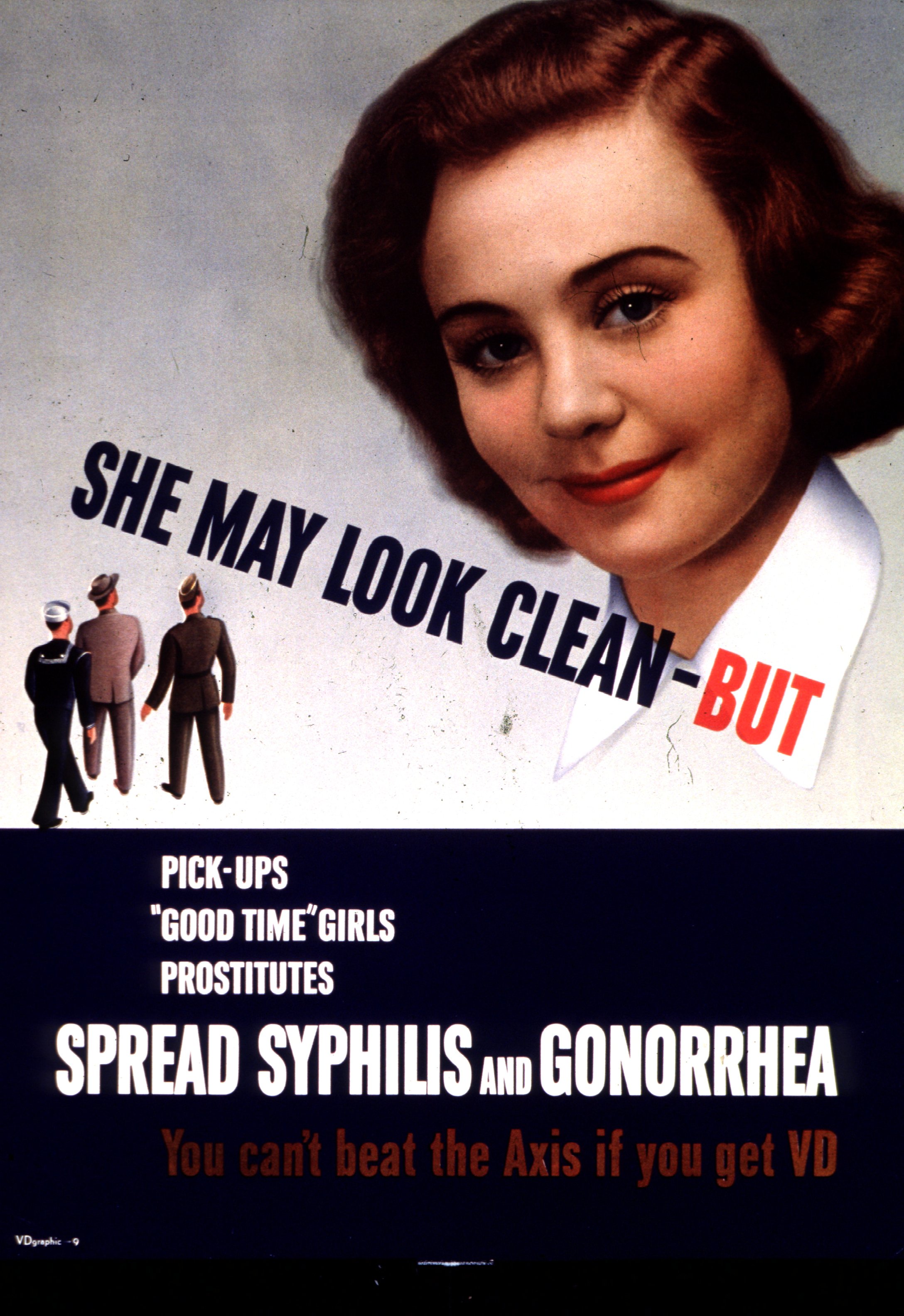 A lot of what I do at work is in support of informational campaigns, often it's blatant advertising. Usually these campaigns are for internal audiences, but some campaigns that we've supported are external. For the external ones, think mostly regional and low-level national.
Yesterday, one of my coworkers was looking at old-school propaganda online and came across this little gem to the right, here. It really cracked me up, for various reasons, but also kind of bummed me out, as well.
My first reaction is that it's hilarious that the government will tie anything and everything
to whatever the current national effort is: "Don't dip your wick where it don't belong boys, 'cause if you do, you may as well be handing the keys to Il Duce!" The featured girl's face is so apple-pie that even I wouldn't suspect her to have the clap. And, of course, it's easy for me, 60 some years on to laugh at the concerns of my forebears. That's what we do!
However, what bums me out is that this ad just perpetuates the notion that sex - and any consequences that follow - is solely a woman's accountability. Men can't be held accountable for their actions. Those poor souls are programmed to bang anything in their path with an orifice. Women are wily and want to destroy them whether it be with STDs, babies or the allure of that most destructive of all powers, love.
Look, I get it: on the whole, men seek sex more aggressively than women. And men in wartime even more so. And the government and society want to make sure soldiers are healthy. So, I totally understand why that campaign was created, and probably still exists to some extent today. And for sure, I wish there was more of a pop culture notion of sexual discretion and discrimination (not sexism, but partner discrimination).
For instance, one of mine and Honey's current favorite shows is Entourage. We both really like it - though I'm sensing a post soon on it, because I tire of its portrayal of women. However, I have yet to see an episode where someone either doesn't have sex or the show doesn't end with a segue into someone about to get laid. The guys' only goals in life are sex, getting stoned and material goods. They're so promiscuous, I'm astonished they've not mentioned burning pee, yet. And why wouldn't they mention it? Because there's never any indication that they use condoms. It's never discussed. Think about it: when was the last time condom usage was discussed in any movie, TV show or widely and easily accessible morsel of the pop culture diet? Aside from Knocked Up, none comes readily to mind. As one who went through puberty and adolescence in the late 80s and early 90s, I was bombarded with AIDS, and by extension, STD prevention information, a huge chunk of which was dedicated to condom usage. MTV had PSAs every other commercial break; posters about safe sex, waiting and partner discrimination were all over school; Channel One did sex ed segments all the friggin' time. I didn't watch much in the way of 90210, but I seem to remember them, and shows with teen and young adult audiences, at least positively addressing condom usage fairly regularly in the 80s and early 90s. By the time I was 13, I knew full well that a supportive tangent to the "abstinence till marriage ethic" of my household, was the cultural ethic of "know who you're sleeping with; make sure you're both clean; get tested; use condoms." It didn't occur to me not to use condoms by the time I was having sex - even when I was on the pill. And then it just seemed to stop right around 1996. Poof! AIDS wasn't killing as many people, so we can just stop letting condoms get in the way of our sexy characters having sex. Rubbers aren't sexy, so why should we spoil the moment? Where did our pop culture sense of partner discrimination and condom usage go? I would love to see a return to some sense of sexual responsibility on TV and in film.
That mini-rant is to say: I appreciate the government's having wanted to persuade soldiers to be cautious.
But there's still something about that poster that just smarts. Maybe it's that the girl does look so innocent. Certainly, just because you look healthy doesn't mean you are. But there's an interesting dualism in the message of that poster, I think. It's the tacit acknowledgment that boys seek out the "innocent" kind of girls as much as the "slutty" ones, because they're safe: a virgin can't tell you if you're good in bed or bad; she won't have an STD; you can trick her into your pants with the promise of "love." And that that's preferred - because boys can't be expected to only masturbate! And the flipside of this poster goes back to what I brushed up against, earlier: women are out to lure you into a trap; some of them use their innocent looks to ensnare you and leave you with a pus-filled penis!
As a society, if we buy that women in relation to sex are to be viewed essentially as succubae, then it makes it easier to punish us for being us. It allows for stupid rape laws, like one I remember reading about in Italy in the 90s: it cannot be considered rape if the purported victim wore blue jeans, because jeans are too difficult to remove and therefore she must've consented. (I really hope that's been struck down.) Or like the legal conversation that comes up every now and then: if the victim asked her aggressor to use a condom, then can it be considered rape? If that's not rape, then I propose a scenario where a man is mugged, stabbed repeatedly and not wanting a withdrawn death, asks his assailant to slit his throat: he hasn't been murdered, he's committed suicide; his attacker should go free. But beyond stupid rape laws, the woman as succubus idea punishes us in other ways: well, if you wanted to make a good living, you shouldn't have had babies; if you wanted to climb the corporate ladder, you shouldn't have worn a short skirt (or worse, you should have). Or in other far less fortunate countries: well, if you wanted to learn to read, you should've been born a boy! Woman, you knew what you were in for - you created sex!
Blech!
It seems as though we're taking a step backward these days what with both anti-sexuality in many abstinence-only movements, and hyper-sexuality in pop culture. It's like those two conflicting points of view are pushing us back, making sex more male oriented and promoting succubus-driven attitudes on sex. However, I do feel, very much, like attitudes towards women, sex and our shared responsibilities have shifted a lot in this country in the last 100, 60, 40 and even 20 years. So for that, I'm tremendously grateful. And if/when Honey and I have children we will definitely instill in them shared sexual responsibility, none of this "boys will be boys" and "girls must be guarded a Swiss bank" bullshit. But I don't look forward to the uphill battle we'll face with the ghosts of that poster in our culture.
Tuesday, January 08, 2008
Looking ahead in my family
It's ten to ten, so let's see if I can whip this out before I want to brush my teeth and hit the hay.
Honey and I went over our anticipated finances for the coming year. I'm feeling much better about the year to come. I'm making more money in my current job than in my last, and Honey has gotten the standard yearly upward bump, so we're better in the piggy than I had thought. Of course, having spent my adolescence poor as a church mouse, I have a constant fear that we could sneeze and end up destitute. Not that that can't happen, but just that I doubt it will anytime soon. Whew!
Speaking of having enough money ... my little brother is probably going to propose to his girlfriend this year. They moved in together this past summer and he'd told me before then that he was sure she was "the one." They've been talking about it between themselves and agree. So I'm happy for him. Especially since she's so much smarter and more sophisticated than his prior interests. But the money part comes in here: he wants to get her a nice ring and is being pressured into the "two-months salary" propaganda that the wicked diamond industry has been snookering love-lorn guys with for years. His girlfriend is not materialistic (despite being well off - woohoo! Way to go, Bro!), so she doesn't care if he spends 2 - 3 months salary on her ring. But I think he's also finding that even if he doesn't cave to the bullshit amounts DeBeers and company guilts men into spending, rings which are something more than a skinny band with a diamond, are higher than $2K or so - the price range I suggested he look in. Anyway, my advice to him was that he should never let money be a reason not to get married. You're going to be with the same person forever, a ring is a ring and a wedding is only one day out of a lifetime (no matter how bloody kick-ass a day it is). I hope he listens. Poor boy, though. I understand the impulse to get something really spectacular for someone you think is really spectacular. A friend of ours had his wife's ring designed, so maybe I'll ask him who he used. I wonder if it would be cheaper to buy the diamond separately and then set it in another ring.
But then that got me thinking about social pressures, and I promise to blog on that more in the future, but it is now 10:03!! And I'm trying to be a good girl and get to bed at a decent hour this year.
Honey and I went over our anticipated finances for the coming year. I'm feeling much better about the year to come. I'm making more money in my current job than in my last, and Honey has gotten the standard yearly upward bump, so we're better in the piggy than I had thought. Of course, having spent my adolescence poor as a church mouse, I have a constant fear that we could sneeze and end up destitute. Not that that can't happen, but just that I doubt it will anytime soon. Whew!
Speaking of having enough money ... my little brother is probably going to propose to his girlfriend this year. They moved in together this past summer and he'd told me before then that he was sure she was "the one." They've been talking about it between themselves and agree. So I'm happy for him. Especially since she's so much smarter and more sophisticated than his prior interests. But the money part comes in here: he wants to get her a nice ring and is being pressured into the "two-months salary" propaganda that the wicked diamond industry has been snookering love-lorn guys with for years. His girlfriend is not materialistic (despite being well off - woohoo! Way to go, Bro!), so she doesn't care if he spends 2 - 3 months salary on her ring. But I think he's also finding that even if he doesn't cave to the bullshit amounts DeBeers and company guilts men into spending, rings which are something more than a skinny band with a diamond, are higher than $2K or so - the price range I suggested he look in. Anyway, my advice to him was that he should never let money be a reason not to get married. You're going to be with the same person forever, a ring is a ring and a wedding is only one day out of a lifetime (no matter how bloody kick-ass a day it is). I hope he listens. Poor boy, though. I understand the impulse to get something really spectacular for someone you think is really spectacular. A friend of ours had his wife's ring designed, so maybe I'll ask him who he used. I wonder if it would be cheaper to buy the diamond separately and then set it in another ring.
But then that got me thinking about social pressures, and I promise to blog on that more in the future, but it is now 10:03!! And I'm trying to be a good girl and get to bed at a decent hour this year.
Wednesday, September 06, 2006
Corruptibility
In an effort to get back into a daily writing routine, I'm going to jot something out this morning before I leave for work. Evidently, when I get home, I'm too zonked to want to do much more than eat, cruise the net and then sleep. Cruise E-bay: who am I kidding?
Anyway, yesterday I was listening to Marketplace on my drive out to meet my professor. I was only halfway listening, so you'll have to click on this link to find out how accurate what i'm about to tell you is. Here's what caught my ear: some sociologist/economist/somebody or other wanted to know how corrupt members of a generally corrupt society were. How do you measure that? On the micro level people always claim to be more morally upright than their governments. He decided to see how people abuse - or don't - diplomatic immunity. He tracked parking tickets of ambassadors and their staff to the UN. What he found was that over an 8 year period, ambassadors to places like Bangladesh and Chad and other countries that have poor human rights records and whom the international community generally agree are corrupt governments, there were thousands of outstanding parking tickets which went unpaid because of diplomatic immunity. However, in the whole of the Scandinavian countries - countries generally who have good human rights records, etc - he found a mere twelve, over 8 years. And most of those were from the guy from Finland. Damn Fins.
Granted, the biggest problem with that fun little exercise is that those individuals represent the corrupt governments, so we'd have to presume they are in fact corrupt individuals. It still doesn't tell us much about the regular folk on the ground. Though, if I were a betting person, I'd bet that many if not most of the people on the ground live corrupt lives as well, simply because that's what you have to do to stay alive. ... in other news, I heard on the radio yesterday - though not a news station, so I can't account for its accuracy - that 12% of the GDP of Mexico is from bribes. Way to go, my peeps. Keep up the embarassment for your American cousins.
Happy Wednesday
Anyway, yesterday I was listening to Marketplace on my drive out to meet my professor. I was only halfway listening, so you'll have to click on this link to find out how accurate what i'm about to tell you is. Here's what caught my ear: some sociologist/economist/somebody or other wanted to know how corrupt members of a generally corrupt society were. How do you measure that? On the micro level people always claim to be more morally upright than their governments. He decided to see how people abuse - or don't - diplomatic immunity. He tracked parking tickets of ambassadors and their staff to the UN. What he found was that over an 8 year period, ambassadors to places like Bangladesh and Chad and other countries that have poor human rights records and whom the international community generally agree are corrupt governments, there were thousands of outstanding parking tickets which went unpaid because of diplomatic immunity. However, in the whole of the Scandinavian countries - countries generally who have good human rights records, etc - he found a mere twelve, over 8 years. And most of those were from the guy from Finland. Damn Fins.
Granted, the biggest problem with that fun little exercise is that those individuals represent the corrupt governments, so we'd have to presume they are in fact corrupt individuals. It still doesn't tell us much about the regular folk on the ground. Though, if I were a betting person, I'd bet that many if not most of the people on the ground live corrupt lives as well, simply because that's what you have to do to stay alive. ... in other news, I heard on the radio yesterday - though not a news station, so I can't account for its accuracy - that 12% of the GDP of Mexico is from bribes. Way to go, my peeps. Keep up the embarassment for your American cousins.
Happy Wednesday
Monday, September 04, 2006
I love Lucy!
Again, I should be doing something productive ... Okay, I already primed the living room so that most of that horrible Robin's Egg Blue is gone, but I mean I should be doing something more productive this instant. Instead, I'm again checking up on my new habit, Lucy over on YouTube.
I found this video made in response to her "Growing Pains" post. Oh, how I wish I knew how to use a camera and cool editing software on my laptop (especially since I work around the damned equipment!), so I could post some cool encouraging post card for her! I would basically tell her what that one guy with the britty accent told her. (And this would go for VirginiaGal, too, since I know she's questioning her decisions and her path right now.) Own your decisions and trust that they are good ones and the ones that need to made right now, and that they will eventually pay off.
Brit guy is very right about "well, med school is right for her, but not for you [Lucy], that's not where your passion is ..." to paraphrase badly. I remember in the year or so after college graduation, many of my friends were going off to either coast to pursue acting full time. I, on the other hand, had moved to Oklahoma to live with my then boyfriend, now husband. After 4 or 5 years of studying acting, I was a little burned out on the craft and wanted a normal life. But I remember feeling guilty about it: I had an acting degree, shouldn't I necessarily be starving in LA or NYC? Everyone else was committing to their careers, shouldn't I be? But one of my cohorts who fled to Chicago to get her career moving helped me put it in perspective: our lives unfold at their own pace and this is where my life is now. Honey is who I want to be with regardless of career and at 24, I had him. We have to grab our opportunities when they're with us. For me, love entered my life before career. I'm 30 and I'm just now getting the whiff of the career path I think I want to pursue. For others - Lucy, for instance - career has presented itself first. Though I often envy people my age (and former classmates) who are further along in their respective careers than I am, I'm ultimately glad about the choice I made. This is my pace. This is my life. It will be good.
I can't help but note the similarity in Lucy's Hollywood life and VirginiaGal's Indian-American life. Both seem to be framed by unrealistic expectations: one determined by unhealthy body image and sexual appeasement by sleazy management types and the other by a community with aging, rigid social prescriptions. Ladies, don't sell out to cheap pressures and unattainable suppositions; you're both far too wonderful to fall prey to others' petty desires. Lucy and VirginiaGal your lives are beautiful and so are you: don't second guess your choices. What you do now, you do because you trust it will make you happier in the long run. I admire you both deeply and am a big fan!
... isn't it adorable how I write this as if someone other than my darling Niamh actually reads this? How goes it in Shropshire, btw, Niamh? How is the box turtle?
I found this video made in response to her "Growing Pains" post. Oh, how I wish I knew how to use a camera and cool editing software on my laptop (especially since I work around the damned equipment!), so I could post some cool encouraging post card for her! I would basically tell her what that one guy with the britty accent told her. (And this would go for VirginiaGal, too, since I know she's questioning her decisions and her path right now.) Own your decisions and trust that they are good ones and the ones that need to made right now, and that they will eventually pay off.
Brit guy is very right about "well, med school is right for her, but not for you [Lucy], that's not where your passion is ..." to paraphrase badly. I remember in the year or so after college graduation, many of my friends were going off to either coast to pursue acting full time. I, on the other hand, had moved to Oklahoma to live with my then boyfriend, now husband. After 4 or 5 years of studying acting, I was a little burned out on the craft and wanted a normal life. But I remember feeling guilty about it: I had an acting degree, shouldn't I necessarily be starving in LA or NYC? Everyone else was committing to their careers, shouldn't I be? But one of my cohorts who fled to Chicago to get her career moving helped me put it in perspective: our lives unfold at their own pace and this is where my life is now. Honey is who I want to be with regardless of career and at 24, I had him. We have to grab our opportunities when they're with us. For me, love entered my life before career. I'm 30 and I'm just now getting the whiff of the career path I think I want to pursue. For others - Lucy, for instance - career has presented itself first. Though I often envy people my age (and former classmates) who are further along in their respective careers than I am, I'm ultimately glad about the choice I made. This is my pace. This is my life. It will be good.
I can't help but note the similarity in Lucy's Hollywood life and VirginiaGal's Indian-American life. Both seem to be framed by unrealistic expectations: one determined by unhealthy body image and sexual appeasement by sleazy management types and the other by a community with aging, rigid social prescriptions. Ladies, don't sell out to cheap pressures and unattainable suppositions; you're both far too wonderful to fall prey to others' petty desires. Lucy and VirginiaGal your lives are beautiful and so are you: don't second guess your choices. What you do now, you do because you trust it will make you happier in the long run. I admire you both deeply and am a big fan!
... isn't it adorable how I write this as if someone other than my darling Niamh actually reads this? How goes it in Shropshire, btw, Niamh? How is the box turtle?
Saturday, July 15, 2006

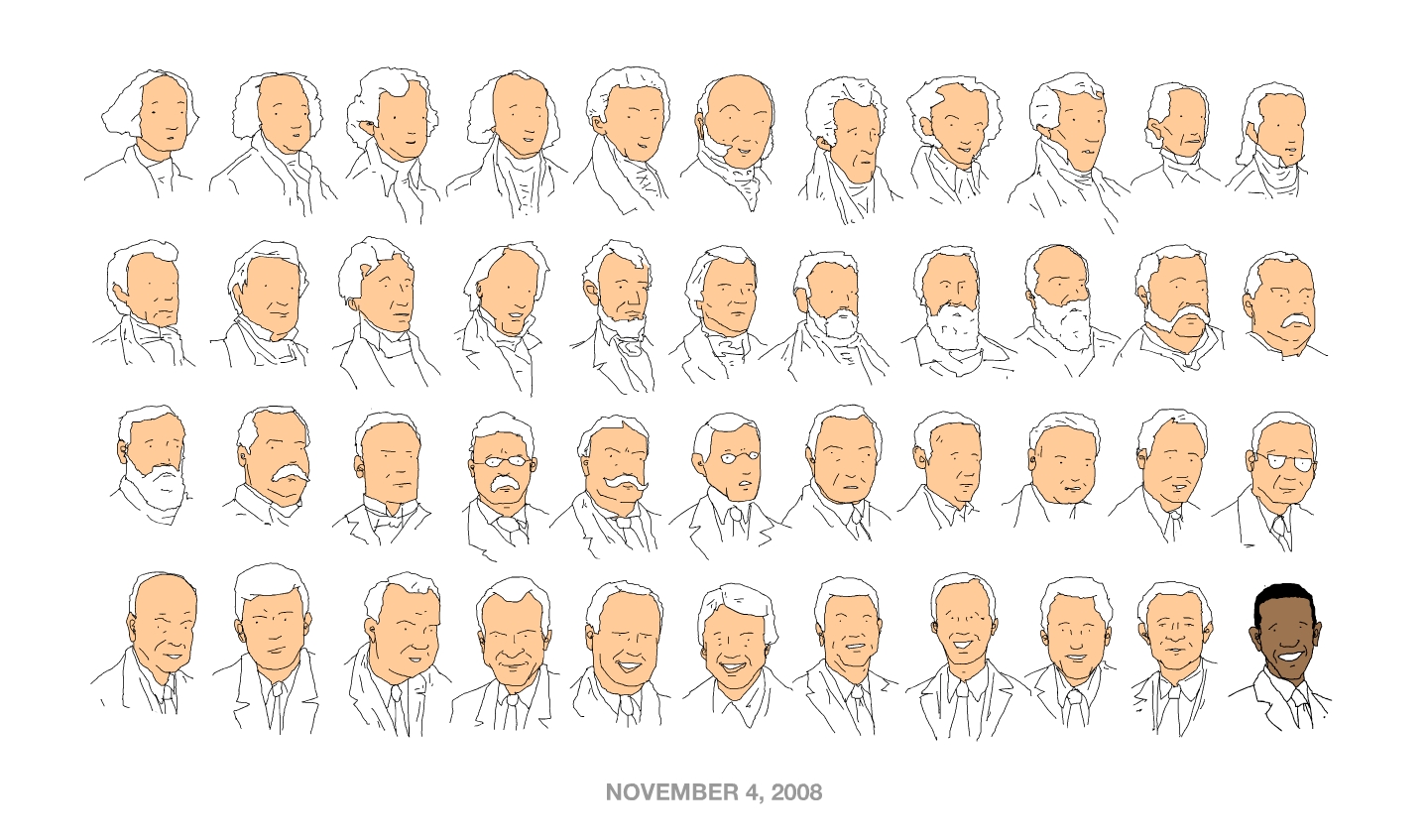
Sunday, May 21, 2006
"Lost" lust and feminist guilt
I've been pretty darned remiss in posting, lately, but not nearly so much as one of my blog-dulgences, TexasWhip. I don't know where those guys have disappeared to. My excuse? I've been hosting guests, working overtime a lot and we're in the process of buying a house, so I have to spend my freetime freaking out.
Since we've been waiting for Battlestar Galatica to resume for season 3, Honey and I have been catching up on that more mainstream TV phenom, Lost. The pilot was so-so, but I've been surprised how quickly we've been drawn in. We're loading up on season one on Netflix. It's crazy. Lost falls into common sentimental traps of TV writing at least once every episode or two, but for the most part, the story is really fascinating. I love the X-files feel to everything. Freaks my ass out. And I recently discovered that the actor who plays the hottie Iraqi soldier, Sayid, for whom I must mop up my drool, is also the same actor who played the lucious Sikh soldier, Kip in the English Patient.
On another note ... Thursday night, a girlfriend and I went to see another mutual girlfriend perform in a play. The show was written in '75 or '76, but basically at the height of the modern feminist movement. I question the director's choice to remount the show. It was just five women monologuing on their lives (our friend's performance, btw, was the best part of the show; she was the most natural and played the most levels. She's almost as much a delight to watch as she is to know.). While I sat there listening to this show, it suddenly occured to me that the basic sentiments being expressed in this piece were the underlying reasons why I feel guilty for not being a bigger breadwinner in my family, for actually wanting to have babies and, on very rare occasions, for being married. The gist of the monologuing women's pieces was this: "My life was what it was: sometimes good, sometimes bad, but my own. And then I met a man and had children, or an abortion. My life was never my own after that and I'm miserable." The only character who wasn't miserable was loopy. The play told me, "You should not be happy." It was also kind of like, between the lines, I could hear the 80s Barbie, saying, "Molly, I told you, 'We girls can do anything!' It's 2006! You're not doing the 'anything' things I was trying to inspire you to do! You may as well be one of these characters!"
I bore in mind that the show was written in the 70s and 30 years ago, this was probably the perfect piece. There's gotta be a period in every social movement when those who are moving up have to work through the demons of why they're moving up. I'm suspicious of groups who do not vent emotionally. But I really failed to see how this piece was compelling today. Though the womens' emotional experiences may not have been anachronistic entirely, it seemed their social experiences were so too far removed from my own understanding of women in America, today (ie, the thought that you can't go to college, just because you're a woman) that it just rang self-important and insincere. All of this could be a by-product of the play's production not supporting the material as well as it could have. I don't know.
To recap, the play tells me: "Marriage makes you lose your sense of self. Family suffocates you. It is better to be lost alone than a lost matron. You should not want these things." But here is what I know: I love my husband with all my being - even when he drives me nuts. I love my marriage with all my heart. And I am very, very happy with both. And for those reasons, I really did not like the theme of the play, as I perceived it. But I definitely congratulate my girlfriend on her performance. Darling, you made that show bearable and thank you, for actually finding the humor in the piece!
Since we've been waiting for Battlestar Galatica to resume for season 3, Honey and I have been catching up on that more mainstream TV phenom, Lost. The pilot was so-so, but I've been surprised how quickly we've been drawn in. We're loading up on season one on Netflix. It's crazy. Lost falls into common sentimental traps of TV writing at least once every episode or two, but for the most part, the story is really fascinating. I love the X-files feel to everything. Freaks my ass out. And I recently discovered that the actor who plays the hottie Iraqi soldier, Sayid, for whom I must mop up my drool, is also the same actor who played the lucious Sikh soldier, Kip in the English Patient.
On another note ... Thursday night, a girlfriend and I went to see another mutual girlfriend perform in a play. The show was written in '75 or '76, but basically at the height of the modern feminist movement. I question the director's choice to remount the show. It was just five women monologuing on their lives (our friend's performance, btw, was the best part of the show; she was the most natural and played the most levels. She's almost as much a delight to watch as she is to know.). While I sat there listening to this show, it suddenly occured to me that the basic sentiments being expressed in this piece were the underlying reasons why I feel guilty for not being a bigger breadwinner in my family, for actually wanting to have babies and, on very rare occasions, for being married. The gist of the monologuing women's pieces was this: "My life was what it was: sometimes good, sometimes bad, but my own. And then I met a man and had children, or an abortion. My life was never my own after that and I'm miserable." The only character who wasn't miserable was loopy. The play told me, "You should not be happy." It was also kind of like, between the lines, I could hear the 80s Barbie, saying, "Molly, I told you, 'We girls can do anything!' It's 2006! You're not doing the 'anything' things I was trying to inspire you to do! You may as well be one of these characters!"
I bore in mind that the show was written in the 70s and 30 years ago, this was probably the perfect piece. There's gotta be a period in every social movement when those who are moving up have to work through the demons of why they're moving up. I'm suspicious of groups who do not vent emotionally. But I really failed to see how this piece was compelling today. Though the womens' emotional experiences may not have been anachronistic entirely, it seemed their social experiences were so too far removed from my own understanding of women in America, today (ie, the thought that you can't go to college, just because you're a woman) that it just rang self-important and insincere. All of this could be a by-product of the play's production not supporting the material as well as it could have. I don't know.
To recap, the play tells me: "Marriage makes you lose your sense of self. Family suffocates you. It is better to be lost alone than a lost matron. You should not want these things." But here is what I know: I love my husband with all my being - even when he drives me nuts. I love my marriage with all my heart. And I am very, very happy with both. And for those reasons, I really did not like the theme of the play, as I perceived it. But I definitely congratulate my girlfriend on her performance. Darling, you made that show bearable and thank you, for actually finding the humor in the piece!
Tuesday, May 02, 2006
let him live? let him fry?
So the jury is taking a long time deciding whether to give Zacharias Moussaoui the death penalty, and MSNBC suspects this means they may be relucatant to give him the gurney. For what it's worth, I hope they deny him his wish. I really get the feeling that this guy is kind of like Andrea Yates. Crazy and dangerous, but really only dangerous in a very limited setting. I also kind of get the feeling that al Quaeda didn't even want to play with this guy. Like they were like, "Allahu Akbhar Jihad, brother Moussauoi! Hey, why don't you save us a seat in the cafetorium for five minutes and I swear we'll all be right back. We just have to run to the men's room." Like he was the wrong kind of crazy for them or something. Maybe they wanted him to get busted. Maybe they were even afraid of flying with him. ... Anyway, if the jury gives him the death penalty, it seems they'd be granting this lunatic the martyrdom he wants. Why play into al Quaeda's hands? ... I'm just sayin' ...
In the meantime, I'm trying to survive a yucky sinus infection and buy a house and maintain my career. My days have improved since my last entry, but not out of the woods. Methinks I'm entering that part of my adulthood where it's all woods. Great. (blech.)
Off to swig the O.J. and get going to work. Ciao!
In the meantime, I'm trying to survive a yucky sinus infection and buy a house and maintain my career. My days have improved since my last entry, but not out of the woods. Methinks I'm entering that part of my adulthood where it's all woods. Great. (blech.)
Off to swig the O.J. and get going to work. Ciao!
Wednesday, February 08, 2006
I want Hot Chocolate!
I sit here today in a neighborhood bakery having just finished a blueberry bagel and a half pint of milk. Mmm, good. There is a preschool here this morning touring the facilities to learn how bakeries work and what bakers do. It's adorable. The kids are made to wear little plastic gloves while they're back in the baking area. But it's to no real avail. They still stick their fingers in their mouths and pick their noses. So much for a germ free environment! It's so precious, I almost want to cry.
A moment ago, they got to take turns using the PA system calling out orders. "Bagel!" "Lemonade!" and my favorite, "Tart!" which of course sounds more like "taut." I'm listening to one of the bakery reps telling the children that the bakers come in very very early in the morning to bake. "They sleep while you're at school," she tells them. They must think bakers are a whole other species; like bats!
... so I did some more reading about the tempest in a teapot that is the global Muslim reaction to the tasteless Danish cartoons. This article doesn't really go that deeply into it, but apparently the whole thing began with a children's book author. He had written a book for children about Islam, and couldn't find any illustrators for his book. The ones he had contacted all refused because they were afraid if they drew an image of Muhammad, they'd meet the same fate as Dutch filmmaker Theo Van Gogh. I have no idea if the children's book was meant as a mockery or like so many children's Bible and Torah storybooks I've seen in my life. The Danish paper Jyllands-Posten printed the story about the author's dilemma and then offered the challenge to 25 illustrators to draw Muhammad as they saw him. Apparently, when the Danes didn't appologize to the a Danish Muslim group, they took their issue to Middle East counterparts. And so, four months after the original printings, we've got burned embassies, dead protestors and enough charred effigies of Denmark's leader to fill an Ash Wednesday urn.
Yesterday, I viewed the twelve. I would say 7 or 8 of them are tasteless and about 6 flat out offensive. Of the other four, however, some of them are mere depictions: a man leading a donkey in the desert, could'a been any shepherd; a crescent and star with the face of a turbanned man in it. With most of them, if you didn't know you were supposed to be looking at Muhammad, you probably wouldn't know. That probably stems from the fact that unlike Christianity which after 2,000 years of popular art kind of has a standard "this is what Jesus looks like" image, Islam has no standard, so looking at the images you just think: oh, uh, dude with a turban and a beard. One, which I thought was kind of funny, had a line up of scraggly looking guys with beards, some of them turbanned, others not, and the person viewing the line up says something to the effect of, "I really don't know which one he is." That seems to be a comment on the image ban - how would you know? One didn't included any image of Muhammad, but rather a guy at a chalk board complaining about the image ban. Another showed an artist drawing an image of the Prophet, furtively, in the dark, so as not to be "caught." One showed a duo of scimitared angry men charging, only to be stayed by Muhammad's hand: "Don't bother with them," he tells them, "They are just ignorant unbeliever Danes." I'm sure that can be seen as offensive, but the fact that Muhammad stops them, seems to me to give the Prophet a credit toward tolerance that the Western world seems to ignore. On the whole, I thought the exercise was iffy. On the one hand, I kind of thought the invitation for images kind of set up an environment of "Hey, let's be an asshole." On the other, I thought it produced some interesting pieces, which, as good political cartoons should, add to the dialogue. But it doesn't sound like satire is a concept many Islamic republics and monarchies.
Many of the cartoons were indeed offensive and out-right meanspirited. But others were good: if not just plain depictions, then reflections of how western artists feel stymied in discussing Islam in public. I know there are many people who find The Davinci Code and the Last Temptation of Christ as offensive to Christianity and their personal relationship with God as Muslims find any depiction (whether positive or negative) of Muhammad. But to my knowledge, none of the DaVinci code protestors have burned the house of Dan Brown or Ron Howard or Kazantzakis or Scorsese. If these images are that offensive, is violence the only proper response? Protest - yes. Boycott - why not? But kidnapping, burning embassies, firing guns into the air, carrying signs that call for the 9/11 of London? What the hell does that do? Just reinforce the fearful, ugly stereotype that the West has of Muslims. And who does that help? Not Muslims. And not the West. Jyllands-Posten was intolerably tasteless to instigate, but it seems the Middle East response just plays into their prejuecies, and is in and of itself intolerable.
Whom I feel sorriest for is the children's author and the children who will now be denied a book about Islam. I'm giving him the benefit of the doubt and assuming he was writing a book for children about Islam so that little non-Muslim Danish children could learn about their Muslim friends. Or so that Muslim parents could better teach their own children. But it looks like that won't happen anytime soon.
I hope this all blows over. I want to laugh again.
A moment ago, they got to take turns using the PA system calling out orders. "Bagel!" "Lemonade!" and my favorite, "Tart!" which of course sounds more like "taut." I'm listening to one of the bakery reps telling the children that the bakers come in very very early in the morning to bake. "They sleep while you're at school," she tells them. They must think bakers are a whole other species; like bats!
... so I did some more reading about the tempest in a teapot that is the global Muslim reaction to the tasteless Danish cartoons. This article doesn't really go that deeply into it, but apparently the whole thing began with a children's book author. He had written a book for children about Islam, and couldn't find any illustrators for his book. The ones he had contacted all refused because they were afraid if they drew an image of Muhammad, they'd meet the same fate as Dutch filmmaker Theo Van Gogh. I have no idea if the children's book was meant as a mockery or like so many children's Bible and Torah storybooks I've seen in my life. The Danish paper Jyllands-Posten printed the story about the author's dilemma and then offered the challenge to 25 illustrators to draw Muhammad as they saw him. Apparently, when the Danes didn't appologize to the a Danish Muslim group, they took their issue to Middle East counterparts. And so, four months after the original printings, we've got burned embassies, dead protestors and enough charred effigies of Denmark's leader to fill an Ash Wednesday urn.
Yesterday, I viewed the twelve. I would say 7 or 8 of them are tasteless and about 6 flat out offensive. Of the other four, however, some of them are mere depictions: a man leading a donkey in the desert, could'a been any shepherd; a crescent and star with the face of a turbanned man in it. With most of them, if you didn't know you were supposed to be looking at Muhammad, you probably wouldn't know. That probably stems from the fact that unlike Christianity which after 2,000 years of popular art kind of has a standard "this is what Jesus looks like" image, Islam has no standard, so looking at the images you just think: oh, uh, dude with a turban and a beard. One, which I thought was kind of funny, had a line up of scraggly looking guys with beards, some of them turbanned, others not, and the person viewing the line up says something to the effect of, "I really don't know which one he is." That seems to be a comment on the image ban - how would you know? One didn't included any image of Muhammad, but rather a guy at a chalk board complaining about the image ban. Another showed an artist drawing an image of the Prophet, furtively, in the dark, so as not to be "caught." One showed a duo of scimitared angry men charging, only to be stayed by Muhammad's hand: "Don't bother with them," he tells them, "They are just ignorant unbeliever Danes." I'm sure that can be seen as offensive, but the fact that Muhammad stops them, seems to me to give the Prophet a credit toward tolerance that the Western world seems to ignore. On the whole, I thought the exercise was iffy. On the one hand, I kind of thought the invitation for images kind of set up an environment of "Hey, let's be an asshole." On the other, I thought it produced some interesting pieces, which, as good political cartoons should, add to the dialogue. But it doesn't sound like satire is a concept many Islamic republics and monarchies.
Many of the cartoons were indeed offensive and out-right meanspirited. But others were good: if not just plain depictions, then reflections of how western artists feel stymied in discussing Islam in public. I know there are many people who find The Davinci Code and the Last Temptation of Christ as offensive to Christianity and their personal relationship with God as Muslims find any depiction (whether positive or negative) of Muhammad. But to my knowledge, none of the DaVinci code protestors have burned the house of Dan Brown or Ron Howard or Kazantzakis or Scorsese. If these images are that offensive, is violence the only proper response? Protest - yes. Boycott - why not? But kidnapping, burning embassies, firing guns into the air, carrying signs that call for the 9/11 of London? What the hell does that do? Just reinforce the fearful, ugly stereotype that the West has of Muslims. And who does that help? Not Muslims. And not the West. Jyllands-Posten was intolerably tasteless to instigate, but it seems the Middle East response just plays into their prejuecies, and is in and of itself intolerable.
Whom I feel sorriest for is the children's author and the children who will now be denied a book about Islam. I'm giving him the benefit of the doubt and assuming he was writing a book for children about Islam so that little non-Muslim Danish children could learn about their Muslim friends. Or so that Muslim parents could better teach their own children. But it looks like that won't happen anytime soon.
I hope this all blows over. I want to laugh again.
Subscribe to:
Posts (Atom)